


AVS Ki Pathshala · Class 12 English Grammar · CBSE & UP Board
Class 12 English Grammar: Direct और Indirect Speech के नियम
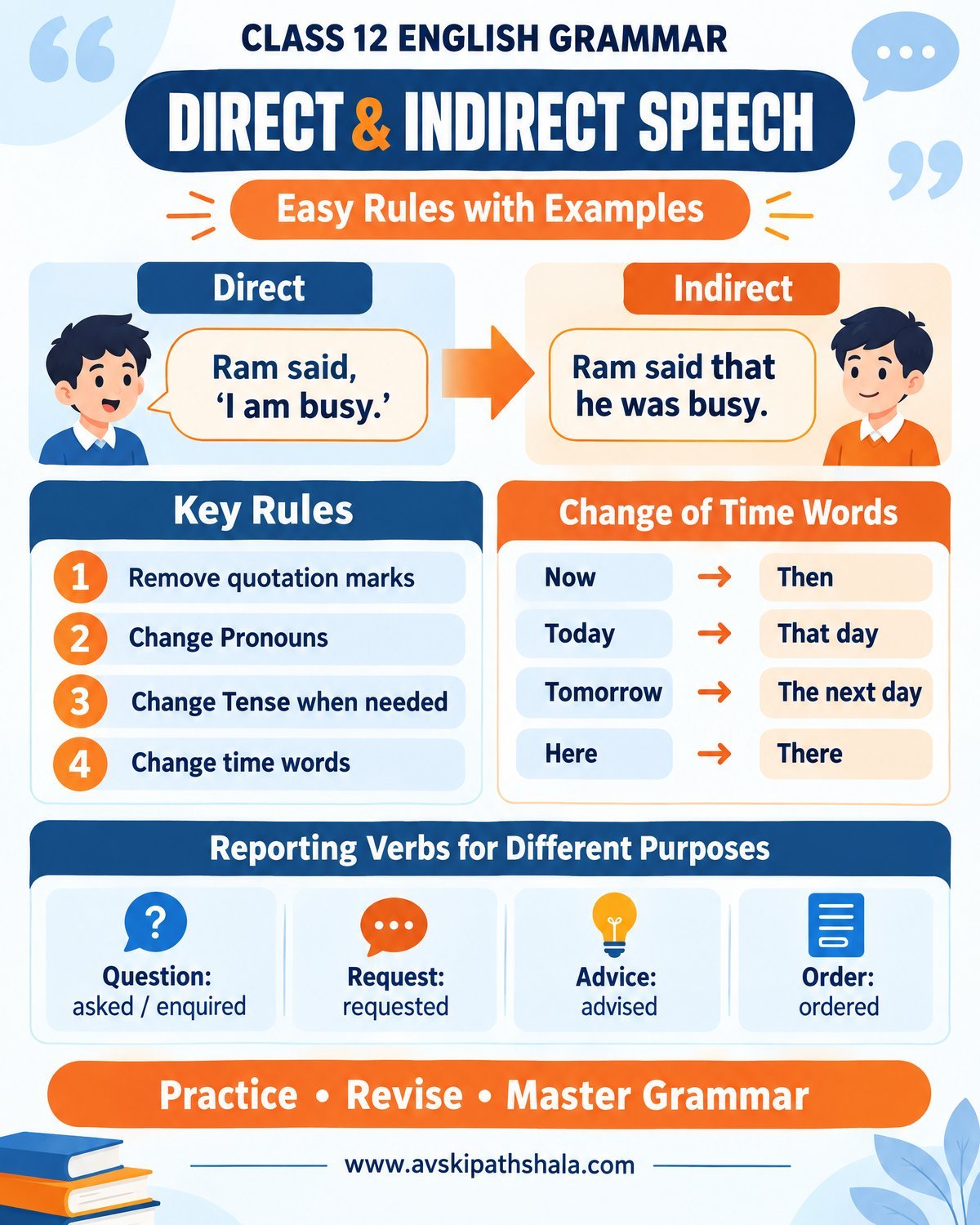
Direct Speech में किसी व्यक्ति के शब्दों को उसी रूप में लिखा जाता है, जबकि Indirect Speech में उसके कथन को अपने शब्दों में बताया जाता है।
Direct Speech
जब वक्ता के वास्तविक शब्द Quotation Marks में लिखे जाते हैं, तो उसे Direct Speech कहते हैं।
Example:
Ram said, “I am busy.”
Indirect Speech
जब वक्ता के कथन को बिना Quotation Marks के बताया जाता है, तो उसे Indirect Speech कहते हैं।
Example:
Ram said that he was busy.
Direct से Indirect Speech में बदलने के नियम
Rule 1: Quotation Marks हटा दिए जाते हैं
Direct Speech में लगे Inverted Commas को हटा दिया जाता है।
Rule 2: Reporting Verb के अनुसार Connector
Statement में सामान्यतः that का प्रयोग किया जाता है।
Example:
He said, “I am happy.”
He said that he was happy.
Rule 3: Pronoun में परिवर्तन
Pronoun का परिवर्तन Subject और Object के अनुसार किया जाता है।
Example:
She said, “I am ill.”
She said that she was ill.
Rule 4: Tense में परिवर्तन
यदि Reporting Verb Past Tense में हो, तो Reported Speech का Tense सामान्यतः बदल जाता है।
Present Indefinite से Past Indefinite
Direct: He said, “I play cricket.”
Indirect: He said that he played cricket.
Present Continuous से Past Continuous
Direct: She said, “I am reading.”
Indirect: She said that she was reading.
Present Perfect से Past Perfect
Direct: He said, “I have completed my work.”
Indirect: He said that he had completed his work.
Past Indefinite से Past Perfect
Direct: Ram said, “I bought a book.”
Indirect: Ram said that he had bought a book.
Tense में परिवर्तन नहीं होता
यदि कथन सार्वभौमिक सत्य हो, तो Tense नहीं बदलता।
Example:
The teacher said, “The earth moves around the sun.”
The teacher said that the earth moves around the sun.
समय और स्थान बताने वाले शब्दों में परिवर्तन
| Direct Speech | Indirect Speech |
|—|—|
| Now | Then |
| Today | That day |
| Tomorrow | The next day |
| Yesterday | The previous day |
| Here | There |
| This | That |
| These | Those |
| Last night | The previous night |
Imperative Sentence
आदेश, सलाह या निवेदन वाले वाक्यों में ordered, requested, advised या told का प्रयोग किया जाता है।
Example:
Direct: The teacher said to the students, “Work hard.”
Indirect: The teacher advised the students to work hard.
Direct: He said to me, “Please help me.”
Indirect: He requested me to help him.
Interrogative Sentence
प्रश्नवाचक वाक्य में asked या enquired का प्रयोग किया जाता है।
Example:
Direct: He said to me, “Are you ready?”
Indirect: He asked me if I was ready.
Direct: She said, “Where do you live?”
Indirect: She asked where I lived.
Exclamatory Sentence
विस्मयादिबोधक वाक्यों में exclaimed with joy, sorrow, surprise आदि का प्रयोग किया जाता है।
Example:
Direct: He said, “Hurrah! We have won the match.”
Indirect: He exclaimed with joy that they had won the match.
Practice Exercise
Indirect Speech में बदलिए:
- He said, “I am tired.”
- She said to me, “Please help me.”
- Ram said, “I have completed my homework.”
- The teacher said, “The earth is round.”
- He said to me, “Where do you live?”
Answers
- He said that he was tired.
- She requested me to help her.
- Ram said that he had completed his homework.
- The teacher said that the earth is round.
- He asked me where I lived.
निष्कर्ष:
Direct और Indirect Speech में परिवर्तन करते समय Reporting Verb, Pronoun, Tense और समय-सूचक शब्दों पर विशेष ध्यान देना चाहिए।


